International Karate
- Medium
- Disk
- Year
- 1986
- Publisher
- System 3 Software (UK); released in the US by Epyx as World Karate Championship
- Type
- Game
- Category
- One-on-one martial arts
- Developer
- Archer Maclean (code and graphics); Rob Hubbard (music)
- Language
- 6502 machine language
- Requirements
- 48K Atari 8-bit (as stated on the disk box), disk or cassette, one or two joysticks
- Tags
- fighting, martial-arts, system-3, archer-maclean, rob-hubbard, 1986, disk, cassette, two-player
Overview
International Karate is the fighting game Atari 8-bit owners remember best. It is a clean one-on-one bout between a white-jacketed and a red-jacketed karateka, refereed by a "wise old judge" who awards full and half points for each scoring blow. Archer Maclean wrote the code and drew the graphics, and Rob Hubbard composed the music. System 3 published it in the UK in 1986, and Epyx released it in the US as World Karate Championship. Players still call it "the gold standard" of 8-bit fighting games and praise its simple controls, satisfying sound effects and Hubbard's soundtrack. It was the sibling-rivalry game of choice in many households.
Gameplay
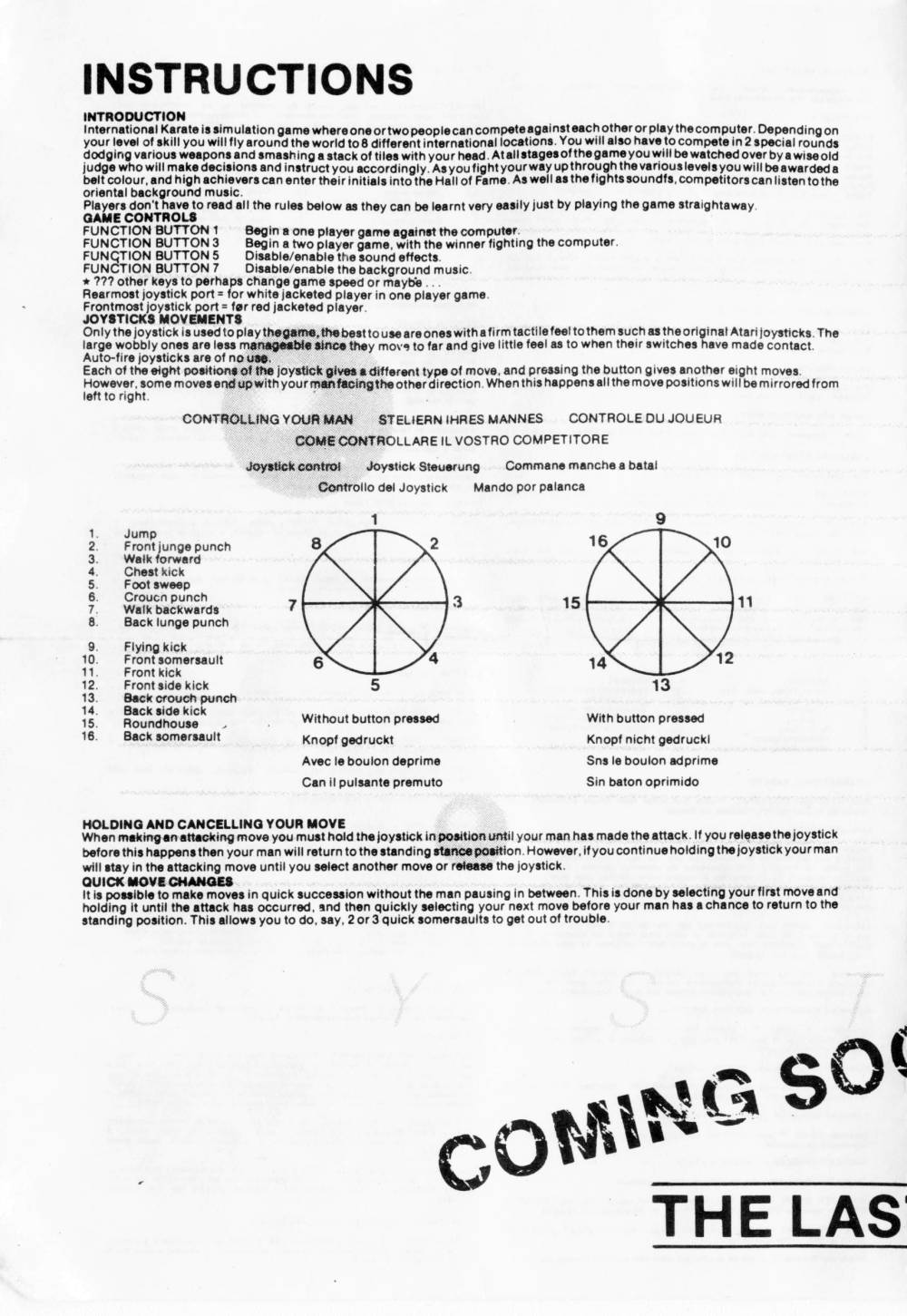
Each of the joystick's eight directions gives a different move, and holding the fire button gives eight more, so you have sixteen in all. Without the button you get jump, front lunge punch, walk forward, chest kick, foot sweep, crouch punch, walk backwards and back lunge punch. With the button you get flying kick, front and back somersaults, front kick, front and back side kicks, back crouch punch and roundhouse. If your fighter ends up facing the other way, all the directions mirror.
Hold the stick until an attack lands, or your man returns to his stance. Chain moves quickly to throw two or three somersaults in a row and escape trouble. Walking backwards puts you into a block against head and stomach attacks at close range, but not against shin kicks or foot sweeps. To avoid those you have to jump or counter-attack.
- Scoring: the judge awards a full point or a half point for each hit, and you also score according to the move. The flying kick and roundhouse are worth 1,000 for a full point, and lunge punches and face kicks 800. The first fighter to two full points wins the bout, and the time left on the 30-second clock becomes a bonus.
- One player: you fight the computer in cycles of three bouts, then a bonus stage. In one you smash a stack of ten tiles with your head, scoring 100 per tile and 2,000 for all ten. In the other you dodge a set sequence of stars, spears and swords. Your score earns you belt colours up to black belt, but one lost bout ends the game. High scorers enter their initials in the Hall of Fame.
- Two players: a best-of-three match scored on a "tug-of-war" bar of white and red markers. The winner goes on to fight the computer.
Between bouts the fight tours the world. The disk version has seven backdrops, including Sydney, New York City, Mount Fuji and Poseidon's temple. The cassette carries six, split across its two sides.
Behind the scenes
Maclean said the game began as someone else's project. He was asked to help improve the graphics, "ended up taking the whole project over and redoing most of it from scratch." The Atari version uses a character-based graphics mode with player/missile graphics laid underneath the fighters for extra colour, a technique Atari coders still cite when planning detailed fighting games. An early beta survives. It has no sound, just three backdrops (Sydney, New York City and Mount Fuji), and OPTION switches between them.
Versions and remakes
- System 3 (UK, 1986): disk (48K) and cassette.
- Epyx (US): released as World Karate Championship.
- Later fan versions: an eight-backdrop file version for 128K machines that adds London; an "Enhanced IK" from 2014; and International Karate RC and RCX, 2023 modifications by Homesoft. In the mid-2000s an East European group worked on porting the sequel, International Karate +.
Playing it today
- Media: boot the disk image on a 48K or larger machine with BASIC disabled. The cassette version loads in stages, so expect to turn the tape over to reach the other backdrops. The 128K fan version needs a 130XE configuration.
- Controls: a joystick in port 1 for one player. The instructions recommend a firm-feeling joystick, like the original Atari stick, and warn that autofire is useless here. Plug in a second stick for two-player bouts.
- Fast loading: the game is a popular test title for high-speed SIO setups. It loads happily over SIO2PC with RespeQt and a high-speed OS patch.
- Tip: the foot sweep and the flying kick are hard to block. Learn to jump them, and remember that a half point from a quick jab still counts toward winning the bout.
Credits
- Picture: System 3's disc version box, marked 'for CBM64 and all Atari 8-bit home computers, minimum memory required: 48K'. — Box scan from AtariMania (International Karate, Atari 8-bit, System 3) (Box art © System 3 Software 1986 — used for identification/commentary)
- AtariMania — International Karate (System 3), live page with credits and the James Hague / Archer Maclean interview excerpt — Box scan from AtariMania (International Karate, Atari 8-bit, System 3) (Box art © System 3 Software 1986 — used for identification/commentary)
- AtariMania — International Karate beta — AtariMania
- International Karate instruction sheet scans (AtariMania), read visually: moves, rules, scoring — AtariMania
- Gury's Atari 8-bit portal — International Karate RC and RCX (2023, Homesoft) — Gury (Atari 8-bit Forever portal), 2023
- AtariAge — 'Noob Atari 8-bit development and graphics questions' (IK's character-mode technique) — AtariAge forum members
- AtariAge — '"The dude" - new WIP beatemup' (PMG underlay as in IK) — AtariAge forum members
- AtariAge — 'Running Hias' High Speed SIO Patch within RespeQt' — AtariAge forum members