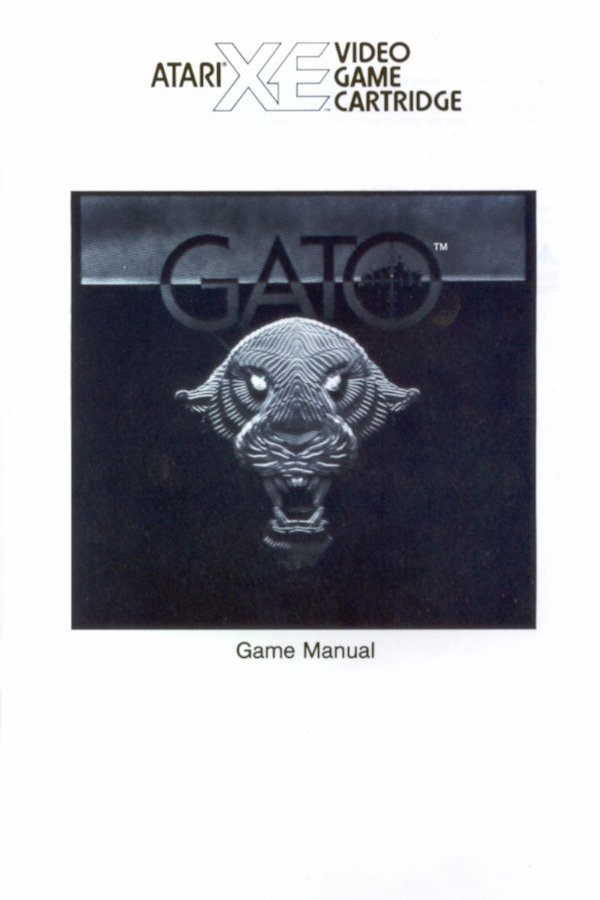
GATO
- Medium
- Cartridge
- Year
- 1987
- Publisher
- Atari Corp. (licensed from Spectrum HoloByte)
- Type
- Game
- Category
- Submarine simulation (World War II)
- Developer
- James Yee (XE conversion); original game by Spectrum HoloByte
- Language
- 6502 machine language
- Requirements
- Atari XE Game System with keyboard, or XL/XE computer (48K per Antic); joystick; optional XF551 or 1050 drive for the Captain's log
- Tags
- simulation, submarine, ww2, strategy, cartridge, xegs, atari-corp, spectrum-holobyte, 1987
Overview
GATO is a World War II submarine simulation, originally a disk hit from Spectrum HoloByte, which Atari Corp. converted to a cartridge (RX8090) for the XE Game System. The label carries a 1985 Spectrum HoloByte copyright and a 1987 Atari one. Atari promised it for spring 1988, and it shipped around June that year. The conversion is credited to James Yee. Unlike most XEGS cartridges, it needs the keyboard, because almost everything except steering and firing is done with keys.
It is 1943. You command USS Growler, a Gato-class attack submarine in the Pacific, taking orders from COMSUBPAC in Morse code. Antic's David Plotkin reviewed the cartridge in September 1988. He found the graphics only adequate, with jerky ship movement, weak torpedo hits and limited sound, and he missed a range-to-target readout for leading your shots. He still called it "quite playable", with real strategic planning in every attack and hair-raising escapes, and concluded that the XE version "is a lot of fun".
Gameplay
A patrol means completing as many missions as you can before returning to your sub tender for fuel, repairs and torpedoes. Missions include intercepting convoys, sinking destroyers, scouting islands, rescuing stranded allied forces and resupplying coastal spotters. Press M for new orders at any time.
You move between nine screens:
- Main control. The bridge view, or the periscope with crosshairs down to 45 feet, looking forward, aft, port or starboard (F/A/P/S, 90° each). The instruments show depth, speed, heading, fuel (400 tons when full), battery charge (1,000 when full), oxygen and torpedoes. You start with 24 torpedoes and four tubes.
- Patrol area chart (C), a map of 20 quadrants. Quadrant chart (Q), with shoals and reefs. Radar (R), with slightly longer range than the periscope, usable down to 45 feet.
- Damage report (D) and Captain's log (L), which lists every ship and the total tonnage you've sunk.
Submarine handling: - Diesels (E) give up to about 20 knots on the surface and recharge the batteries. Below 20 feet you must switch to batteries (B), with a top speed of under 9 knots. Keys 1–5 set speed from flank to slow, 9 is reverse and 0 stops. - The joystick steers and works the dive planes, and the fire button launches torpedoes. T opens and closes the torpedo doors, which add drag. Shift + * raises the periscope. - Crush depth is 425 feet. Oxygen runs down while you are submerged and refills once you surface on diesels.
Combat: torpedoes travel at 60 knots, so lead moving targets. Once you've hit a ship, or been sighted, escorts will hunt you with depth charges. Keep changing speed, heading and depth, or "run silent, run deep". To resupply, come up behind the sub tender and match its course and speed. And don't torpedo it.
Options
The game-control screen sets difficulty 0–9. At levels 0–3, enemy ships appear on both charts. At 4–5 they appear only on the quadrant chart, and at 7–9 Morse orders come only as sound, so it helps to know Morse code. You can also turn sound on or off (turning it off speeds up messages) and choose day or night patrols. Up to four players take turns, each with their own Captain's log.
A hidden shortcut, Rapid Submarine Deployment, saves long transits. On the patrol chart, press Z, enter the password ATARI, and type the X,Y coordinates of your destination. It won't save you from an enemy that already has you on sonar.
Playing it today
Load the cartridge on an XL/XE in Altirra or Atari800. You'll need the computer keyboard, so don't run it as a keyboard-less XEGS. To keep a permanent Captain's log, attach a formatted DOS disk (not write-protected) as drive 1 before starting. Without one, the log is lost when you switch off or press RESET.
Credits
- Picture: The XE cartridge (RX8090), licensed from Spectrum HoloByte. — Cartridge scan from AtariMania
- AtariMania — GATO (Atari, 1987, RX8090; coder James Yee; 18-page manual scans) — Cartridge scan from AtariMania, 1987
- GATO XE Video Game Cartridge game manual (Atari Corp.) — scans on AtariMania (OCR) — AtariMania
- Antic Vol. 7 No. 5 (September 1988) — Product Reviews: Gato, by David Plotkin — AtariMagazines.com (Kevin Savetz), 1988
- comp.sys.atari.8bit FAQ (Michael Current) — Gato (title by Spectrum Holobyte) announced 1987, due spring 1988; 'June?: Atari shipped: Gato (Xanth F/X)' — Michael Current (comp.sys.atari.8bit FAQ), 1987