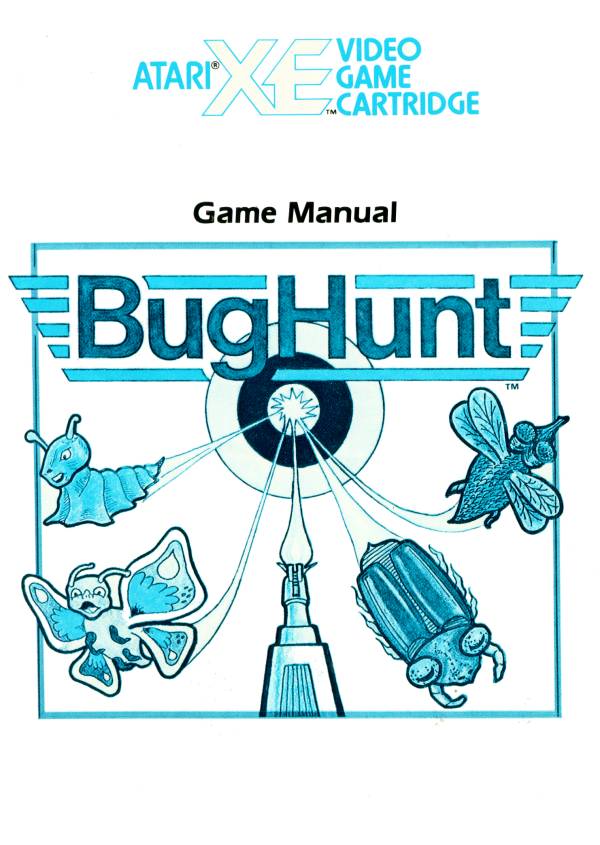
Bug Hunt
- Medium
- Cartridge
- Year
- 1987
- Publisher
- Atari Corp.
- Type
- Game
- Category
- Light-gun shooting gallery
- Developer
- Robert Zdybel, Alan Murphy
- Language
- 6502 machine language
- Requirements
- Atari XE Game System or XL/XE computer; XG-1 light gun; CRT TV or monitor
Overview
Bug Hunt (cartridge RX8087) was the game that showed off the XG-1 light gun packed with the Atari XE Game System in 1987. It went through two working titles, Troubleshooter and Blast 'Em, before shipping. It came in the XEGS deluxe package together with the console, keyboard, joystick, light gun and Flight Simulator II. In Europe it was also sold in kits with the XG-1. The programmers were Robert Zdybel and Alan Murphy.
The story is an in-joke about Atari itself. It's late at night, and you are still in the lab debugging your newest computer board, hoping to be recognised as "a true Atari Game Designer". Then real bugs start pouring out across the motherboard, and you reach for your light gun.
Gameplay
The whole game takes place on one green-tinted circuit board with an Atari logo in the corner. Bugs pop up, scurry around and vanish after a few seconds, so you have to shoot quickly.
- There are seven waves, each faster and busier than the last, with up to 31 bugs per wave and more kinds of bug as you go.
- The cartridge counts every trigger pull. At the end of a wave, a status screen shows your score and accuracy (hits as a percentage of shots). If your accuracy is too low for that wave, the game ends. Accuracy also earns bonus points.
- Bugs include flies, weevils, termites, ants, roaches, ticks, a caterpillar, a "Big Bug", a "G-Bug" and even a frog. They are worth from 100 to 3,000 points, and fast versions score more than slow ones.
- Your final rating pokes fun at the computer industry. It goes from CEO (under 10,000 points) up through President, Vice President, Director, Manager, Hacker, Hobbyist, Programmer, Engineer and Technician, to Trouble Shooter at 100,000 or more.
Controls: shoot "Player 1" or "Player 2" on the title screen to start a one- or two-player game (players take turns). SELECT pauses, and RESET ends a game.
The light gun problem
Bug Hunt took the blame for the XG-1's early reputation. When Antic compared the video game systems in March 1988, it complained that the Atari gun wasn't accurate. Three months later, after Barnyard Blaster worked fine with the same gun, David Plotkin concluded that the inaccuracy "apparently should have been attributed to the Bug Hunt software".
Matthew Ratcliff explained why in Antic's August 1988 look inside the XEGS. The XG-1 is really a light pen in the shape of a gun. Its horizontal reading is offset by the delay between a pixel lighting up and POKEY latching the position. Atari's own technical reference recommended calibrating for this each time, but Bug Hunt and Barnyard Blaster both use different fixed values, so Bug Hunt tends to shoot slightly to the left. Both games flash the screen white when you pull the trigger, because the gun needs a bright screen to read reliably. Ratcliff felt the higher waves demanded more accuracy than the XG-1 could deliver. Atari told him that a revised Bug Hunt would be sold with the gun as a separate package.
Reception
Players rate it as a modest pack-in. It is nothing like Nintendo's Duck Hunt, but some find the monochrome graphics attractive, the gun responsive enough, and the game fun for high-score contests at parties. Rob Zdybel later told the full, reportedly hilarious, story of how it was made in an interview on the ANTIC podcast.
Playing it today
On real hardware you need an XG-1 (or another compatible gun) and a CRT, because light guns can't read a flat panel. In Altirra, set up a light gun on port 1, driven by the mouse, and load the cartridge on an XL/XE configuration. Expect to aim a touch to the right to make up for the built-in offset.
Credits
- Picture: Bugs on the motherboard: Bug Hunt's single green-tinted playfield. — Screenshot from AtariMania
- AtariMania — Bug Hunt (Atari, 1987, RX8087; programmers; manual scans; comments) — Screenshot from AtariMania, 1987
- Bug Hunt XE Video Game Cartridge game manual (Atari Corp., 1987) — scans on AtariMania (OCR) — AtariMania, 1987
- Antic Vol. 7 No. 4 (August 1988) — First Look Inside the XE Game System, by Matthew Ratcliff (light gun section) — Matthew Ratcliff; AtariMagazines.com (Kevin Savetz), 1988
- Antic Vol. 7 No. 2 (June 1988) — Atari's 12 New Entertainment Cartridges, by David Plotkin (Barnyard Blaster/Bug Hunt accuracy remark) — AtariMagazines.com (Kevin Savetz), 1988
- comp.sys.atari.8bit FAQ (Michael Current) — Troubleshooter / Blast 'Em / Bug Hunt; XES4001 and XE 2001/5001 packages; light-gun software list — Michael Current (comp.sys.atari.8bit FAQ), 2001