Millipede
- Medium
- Cartridge
- Year
- 1985
- Publisher
- Atari Corp. (developed by Atari, Inc.)
- Type
- Game
- Category
- Arcade shooter (coin-op conversion)
- Developer
- Stephan R. Crandall (program); Gary Johnson (graphics); Brad Fuller (audio)
- Language
- 6502 machine language
- Requirements
- Any Atari 400/800/XL/XE or XEGS; ROM cartridge (RX8048); joystick (a Trak-Ball works in joystick mode)
- Tags
- arcade-conversion, shooter, centipede, cartridge, atari-corp, atari-inc, 1985, classic
- Related
- Moon Patrol, Centipede, Final Legacy, Altirra, Atari800, Asteroids
Overview
Millipede is the home-computer version of Atari's coin-op sequel to Centipede. It was programmed by Stephan R. Crandall, with graphics by Gary Johnson and audio by Brad Fuller. Its working title was Centipede Plus. Atari, Inc. completed the cartridge (RX8048) and promised it for March 1984, and a 1983 prototype survives. Then came the company's sale and break-up, and the finished game didn't reach shops until Atari Corp. released it in spring 1985, alongside Moon Patrol, Final Legacy and Track & Field. Later production cartridges carry a 1986 Atari Corp. label.
Antic gave it three and a half stars out of four in its 1988 round-up of classic cartridges, rating it above the home Centipede, and noted that the arcade Millipede had been more popular thanks to better sound and playability. Players today still often call it one of the best arcade conversions on the 8-bit, closer to real arcade action than other versions, though some find it a little slow at first and later overwhelming, with "way too many different insects all over the screen".
Gameplay
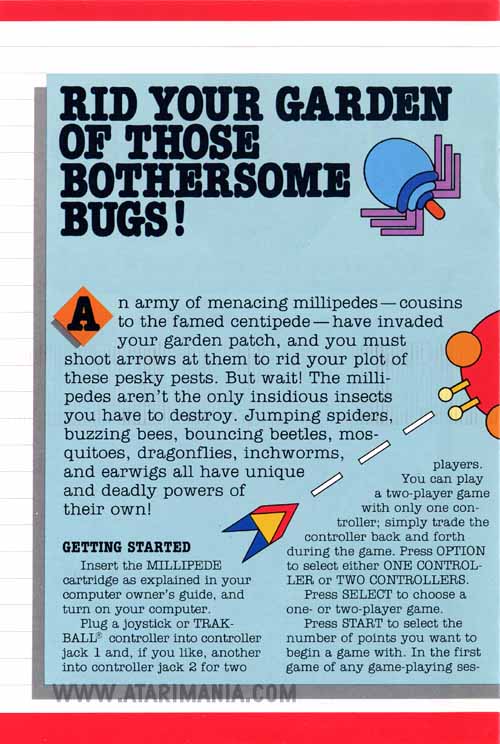
You defend a garden patch from a marching millipede by shooting arrows up the screen from your bug blaster. Each segment you hit becomes a mushroom. When the millipede hits a mushroom, it turns and drops a row. Touch any of it and you lose a life. You start with three lives, plus one extra for every 10,000 points.
A whole ecosystem joins in:
| Pest | Points | Behaviour |
|---|---|---|
| Mushroom | 1 | Slowly crowds out your garden |
| Millipede segment / head | 10 / 100 | Marches down, reversing at each mushroom |
| Spider | 300–1,200 | Jumps in from the sides. The closer it is, the more it's worth |
| Beetle | 300 | Crawls in on a set pattern |
| Mosquito | 400 | Worth a lot, but quick, and swarms |
| Bee | 200 | Buzzes randomly with a distinctive sound, and swarms |
| Inchworm | 100 | Slow, but shooting it slows every insect for about five seconds |
| Dragonfly | 500 | Flies fast and swarms too |
| Earwig | 1,000 | Hard to hit, and poisons mushrooms it touches |
| DDT bomb | 800 | Shoot it to release a gas cloud. Bugs caught in it score triple |
Poisoned mushrooms look different. A millipede that touches one charges straight down at you. When bees, mosquitoes or dragonflies swarm, each insect in the swarm is worth more than the last: 100 extra points for the first, 200 for the second, and so on up to 1,000. Only a spider can enter while a swarm is on. When you lose a life, you get 5 points for every flower, poisoned mushroom and damaged mushroom left on screen.
Controls and options
- OPTION selects one or two controllers. With one, two players simply hand the joystick back and forth. SELECT chooses one or two players.
- START chooses your starting score: 0, 10,000, 20,000 and so on up to 60,000 in the first game. In later games you can start up to 10,000 below your previous high score, as far as 300,000. Push the stick right or left to change it, then press fire to begin.
- The space bar pauses and resumes.
The manual says a Trak-Ball can be used. In fact the game has no true trackball mode. A Trak-Ball works only in its joystick setting, though owners say it still plays fine that way.
Survival tips
- Keep one eye on the millipede while you deal with the other pests. It sneaks up on you.
- Watch for poisoned mushrooms, and shoot earwigs before they can poison more.
- Learn the sounds. Each insect has its own, so you can hear what's coming.
- Time your DDT bombs for when several bugs are close by.
Playing it today
Load the cartridge image in Altirra or Atari800 on any machine. No BASIC or DOS is needed. A good joystick helps a lot, because swarm waves call for rapid fire and fine movement. Use the high-score start option to practise the later waves without playing through the easy opening every time.
Credits
- Picture: An RX8048 cartridge from Atari Corp. The manual cover scan is watermarked, so the cartridge is shown instead. — Cartridge scan from AtariMania
- AtariMania — Millipede (Atari, 1984, RX8048; credits; working title; comments) — Cartridge scan from AtariMania, 1984
- AtariMania — Millipede (1983 prototype) — AtariMania, 1983
- Millipede instruction booklet (Atari Corp., 1985, C014189-48 Rev. B) — scans on AtariMania — AtariMania, 1985
- Antic Vol. 7 No. 3 (July 1988) — Classic Cartridges Revisited — AtariMagazines.com (Kevin Savetz), 1988
- comp.sys.atari.8bit FAQ (Michael Current) — Millipede promised for March 1984; shipped by Atari Corp. March/April 1985 — Michael Current (comp.sys.atari.8bit FAQ), 1984