Draconus
- Medium
- Cassette
- Year
- 1988
- Publisher
- Cognito (Zeppelin Games)
- Type
- Game
- Category
- Arcade adventure (flip-screen platform exploration)
- Developer
- Ian Copeland and Brian Jobling (code), Michael Owens (graphics), Adam Gilmore (music)
- Language
- 6502 machine language
- Requirements
- Atari XL/XE, cassette or disk, joystick; boot with OPTION held to disable BASIC
- Tags
- arcade-adventure, platform, exploration, cassette, disk, zeppelin-games, cognito, 1988, xl-xe
- Related
- Zeppelin, Necromancer, Bounce, Hans Kloss, Zybex, Fred
Overview
Draconus is a large flip-screen arcade adventure for the Atari XL/XE, published in 1988 on tape and disk by Cognito, an imprint at the same Newcastle address as Zeppelin Games (28 Osborne Road, Jesmond). It came from the same team as Zeppelin's shooter Zybex: code by Ian Copeland and Brian Jobling, graphics by Michael Owens and music by Adam Gilmore.
Players remember it as one of the best games on the late-era Atari. Some call it "the best Metroid alternative" on the machine, and it is often listed alongside Polish favourites such as Robbo as a must-play. It holds an average user rating of about 8.1/10.
Gameplay
The setting is an alien planet ruled by the Tyrant Beast, which you must destroy in the game's final scene. To get there you explore a labyrinth of caves, learning to use the planet's "mysteries and magical forces" along the way.
The key idea is that you play two creatures and switch between them:
- Frognum, a tall humanoid, walks, jumps, punches, ducks and breathes fire.
- Draconewt, an aquatic dragon-newt, swims in eight directions and fires a water jet, but can never leave the water.
You change form on a Morph Slab. Pull down while standing on one to become Draconewt, as long as you carry the Morph Helix. Push up beneath one to turn back into Frognum. Large parts of the map are only reachable by switching at the right place.
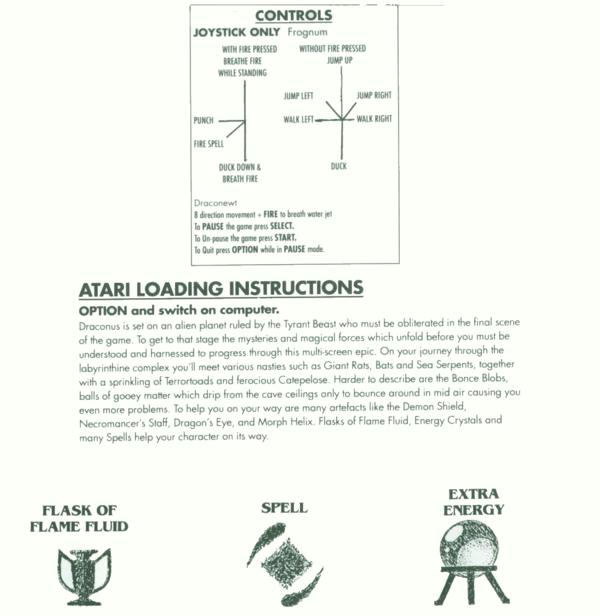
The caves are full of enemies: Giant Rats, Bats, Sea Serpents, Terrortoads, Catepelose, and Bonce Blobs, balls of goo that drip from the ceiling and bounce around in mid-air. Artefacts to find include the Demon Shield, Necromancer's Staff, Dragon's Eye and the Morph Helix, plus spells.
Two energy scrolls run along the bottom of the screen, one for Frognum and one for Draconewt. Flasks of Flame Fluid give Frognum ten fire blasts each, and Energy Packets top up whichever creature you are playing. You have three lives. Falling too far drains Frognum's energy and can kill him, and when you die you restart at the last Record Slab Frognum stood on, so these checkpoints matter. Whatever kills him, the hero's death is memorable: his head explodes.
Behind the scenes
Draconus is a product of the British budget scene that kept the XL/XE alive in Europe in the late 1980s. The Jobling–Owens–Gilmore team also produced Zybex and Speed Ace for Zeppelin. Gilmore's music and the sound effects are often singled out, along with the detailed graphics. The German magazine Zong printed tips and pokes for it in 1989.
The game had a long afterlife in Poland, where a series of follow-ups appeared: Draconus 2: The Story Continues (1991), Draconus 3: The Larger Challenge (1992) and Draconus 4: La Leyenor (1993). Draconus 4 credits the original Copeland/Owens/Gilmore material, with new sound effects by Guillermo Fuenzalida and a "modification" credit for Brian Jobling. Who made these sequels, and whether they were authorised, is unclear.
Playing it today
- Media: Cognito sold it on cassette and disk (serials F100 and F101). A tape dump is the commonly available version, and the original disk image is not preserved.
- Machine: an XL/XE with 64K, as the inlay states. Boot with BASIC disabled; the instructions say to hold OPTION while switching on.
- Joystick as Frognum: without fire, push up to jump, diagonally to jump left or right, left or right to walk and down to duck. With fire held: up breathes fire while standing, left punches, down-left casts a fire spell, down ducks and breathes fire.
- Joystick as Draconewt: eight-way movement, and fire for the water jet.
- Keys: SELECT pauses, START resumes and OPTION while paused quits.
- Difficulty: it takes a while to get into, and many players never beat the final boss. Learn where the Record Slabs are and use them as checkpoints.
Credits
- Picture: The 1988 Cognito cassette inlay, marked 'Atari XL/XE'. — Cognito cassette inlay scan from AtariMania (draconus_zeppelin_k7.jpg) (Box art © Cognito 1988 — used for identification/commentary)
- AtariMania — Draconus (Cognito, 1988) — Cognito cassette inlay scan from AtariMania (draconus_zeppelin_k7.jpg) (Box art © Cognito 1988 — used for identification/commentary), 1988
- AtariMania — Draconus instruction sheet scans (draconus_zeppelin_i.jpg, draconus_zeppelin_i_2.jpg) — AtariMania
- Gury's Atari 8-bit Forever — Draconus 4: La Leyenor — Gury (Atari 8-bit Forever portal)
- Gury's Atari 8-bit Forever — news log 2024-04-13 (Draconus 2 and 3 entries) — Gury (Atari 8-bit Forever portal), 2024
- ZONG magazine index (kekat990) — Draconus tips