Donkey Kong Junior
- Medium
- Cartridge
- Year
- 1983
- Publisher
- Atari, Inc.
- Type
- Game
- Category
- Arcade platformer (single screen)
- Developer
- Kevin Sacher, Jeff Milhorn
- Language
- 6502 machine language
- Requirements
- Atari 400/800/XL/XE or XEGS; ROM cartridge (RX8040); one or two joysticks
- Tags
- arcade-conversion, platformer, nintendo, cartridge, atari-inc, 1983, classic
- Related
- Donkey Kong, Altirra, Atari800, Bounce, Joust, Pole Position
Overview
Nintendo's 1982 coin-op Donkey Kong Junior turned the original upside down. Mario is now the villain and has caged Donkey Kong, and the player controls Kong's son, who has to rescue him. Atari had the home computer rights to both Kong games. It announced the computer version in 1983 and released the cartridge (RX8040) in March 1984, about nine months after Landon Dyer's Donkey Kong. Kevin Sacher and Jeff Milhorn are credited with the conversion.
Like its predecessor, it is a careful conversion with all four arcade scenes. It is also notoriously hard. Reviewing the reissued cartridge for XE Game System owners in August 1988, Antic's Matthew Ratcliff gave it three stars out of four. He rated Donkey Kong a 5 for difficulty and Junior "easily an 8 or 9", admitted he had only rarely got past the first screen, and recommended it to "master arcade gamers with lightning reflexes".
Gameplay
Junior starts with three lives and works through four scenes in a fixed order:
- The Vine Scene. Climb, jump and dodge the Snapjaws to reach the key beside Papa's cage. Junior climbs much faster holding two vines than one, but slides down faster on a single vine. Fruit hanging on the vines can be dropped on Snapjaws below for extra points. Some Snapjaws slide all the way down and drop off, while others turn around and climb back up. The last jump, onto Mario's platform, is the tricky one, because Junior can't jump a Snapjaw while making the leap.
- The Chain Scene. Push six keys up their chains into six locks while Snapjaws and Birds harass you. Two chains are still faster than one.
- The Jump Board Scene. Mario has recaptured Papa. Junior has to bounce off a springboard onto a moving platform, grab a long chain and climb past the dive-bombing Nitpickers and their eggs.
- The Hideout Scene. Mario's fortified hideout replaces the enemies with Globes and Sparks, and the longer Junior takes, the more of these flaming guardians appear.
Free Papa in the last scene and he finally gets his revenge on Mario, who is booted off the screen. Then the cycle starts again at a higher level.
Scoring and the clock. Each scene starts with a bonus countdown that is your time limit: 4,000 at level 0, rising by 1,000 per level to a maximum of 9,000. If it runs out, you lose a life. Dropping fruit earns 400 points. One fruit hitting several attackers is worth 800, then 1,200, then 1,600 for each extra enemy. Jumping an attacker earns 100, and each key locked in the Chain Scene earns 200. You get an extra life at 10,000 points.
Controls
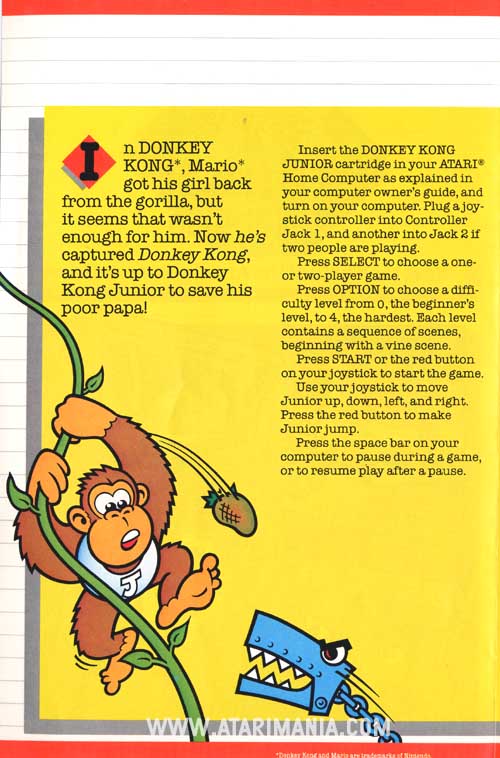
- Joystick moves Junior up, down, left and right. The button jumps.
- SELECT chooses one or two players (alternating, with the second joystick in jack 2).
- OPTION sets the starting difficulty from 0 (beginner) to 4 (hardest).
- START or the button begins, and the space bar pauses and resumes.
The BOOGA cheat
The cartridge hides a developer back door. During a game, hold SHIFT and type BOOGA. Then press K for invincibility, or S to skip to the next scene. Many players who could never get past the chains first saw the later screens this way, after the code was printed in a magazine.
Versions and hacks
- RX8040, 1983, in the silver Atari Home Computers style. Two ROM dumps circulate. They differ in a single bit of the cartridge header, a flag for whether the cartridge is run after initialisation. It makes no difference to play because the game never returns from initialisation.
- After the XE Game System launched, Atari Corp. reissued its warehouse stock in uniform new boxes at $19.95–$22.95. That reissue is the one Antic reviewed in 1988.
- Donkey Kong Junior (Arcade Enhanced), 2015, is a fan hack by the AtariAge member darryl1970. It reworks the graphics and sound to look and sound closer to the coin-op, in the same spirit as his Donkey Kong arcade update.
Playing it today
Load the cartridge image in Altirra or Atari800 on any machine from a 400/800 to an XE. No BASIC or DOS is needed. Start on difficulty 0 to learn the vine scene, and keep both hands on two vines whenever you're climbing. If you only want to see all four scenes, BOOGA-then-S works fine in emulation.
Credits
- Picture: The 1983 Atari Home Computers cartridge (RX8040). — Cartridge scan from AtariMania
- AtariMania — Donkey Kong Junior (Atari, 1983, RX8040; coders, dump notes, BOOGA easter egg, 4-page manual scans, comments) — Cartridge scan from AtariMania, 1983
- Donkey Kong Junior instruction leaflet (Atari, Inc., 1983, C014189-40 Rev. A) — scans on AtariMania — AtariMania, 1983
- Antic Vol. 7 No. 4 (August 1988) — Classic Cartridges II, by Matthew Ratcliff — Matthew Ratcliff; AtariMagazines.com (Kevin Savetz), 1988
- Gury's Atari 8-bit Forever — Donkey Kong Junior; Donkey Kong Junior (Arcade Enhanced) — Gury (Atari 8-bit Forever portal)
- comp.sys.atari.8bit FAQ (Michael Current) — Donkey Kong Junior introduced 1983, released March 1984 — Michael Current (comp.sys.atari.8bit FAQ), 1983