Atari PILOT
- Medium
- Cartridge
- Year
- 1981
- Publisher
- Atari, Inc.
- Type
- Language
- Category
- Educational PILOT interpreter with turtle graphics (cartridge)
- Developer
- Harry B. Stewart
- Language
- 6502 machine language
- Requirements
- Any Atari 400/800/XL/XE with 8K RAM (16K for the demo cassettes); PILOT cartridge CXL4018; cassette or disk optional for saving programs
Overview
PILOT (Programmed Inquiry, Learning, Or Teaching) was created to make computer-aided lessons easy to write. Atari PILOT put it on a cartridge for the 400 and 800 and added two things the original lacked: turtle graphics and access to the Atari's sound. Its commands are one or two letters followed by a colon. T: types text, A: accepts an answer, M: matches it against expected words, J: jumps, C: computes and E: ends. A teacher or a child could write a quiz that accepts "George Washington", "President Washington" or just "Washington" in three or four lines. The 1983 Creative Atari survey called Atari's version "a pretty clean implementation" and praised its documentation.
Features
- Dialogue commands.
T:,A:andM:handle conversation and quizzes.M:matching sets up the special string variables$LEFT,$MATCHand$RIGHT, and Ken Harms later used them for full string parsing. Commands can carry the conditionersYandN(match succeeded or failed), as inTY:orJN:. Labels start with*. - Variables. Numeric variables start with
#and string variables with$.C:@Bnnnreads or writes a single byte of memory, which is PILOT's equivalent of PEEK and POKE. Through it, Antic's columnists reached the colour registers, the sound hardware and redefined character sets. - Turtle graphics.
GR:introduces drawing commands for a turtle you steer by distance and angle rather than by screen coordinates. Pens are namedRED,YELLOW,BLUEandERASE, and any of the 128 Atari colours can be poked into those registers. - Sound.
SO:plays notes on up to four voices at once. Harms grumbled that it controls only pitch, with a fixed bell-like tone, so his "Sounder" column showed how to get full distortion and volume control by poking POKEY directly. - Editing. It uses the Atari screen editor and has an
AUTOline-numbering mode.LOADandSAVEwork with cassette and disk, and programs are conventionally named.PLT.
A classic three-step PILOT exchange looks like this:
10 *QUIZ
20 T:Who was the first president of the United States?
30 A:
40 M:WASHINGTON
50 TY:Correct!
60 TN:No, it was George Washington.
70 E:
Behind the scenes
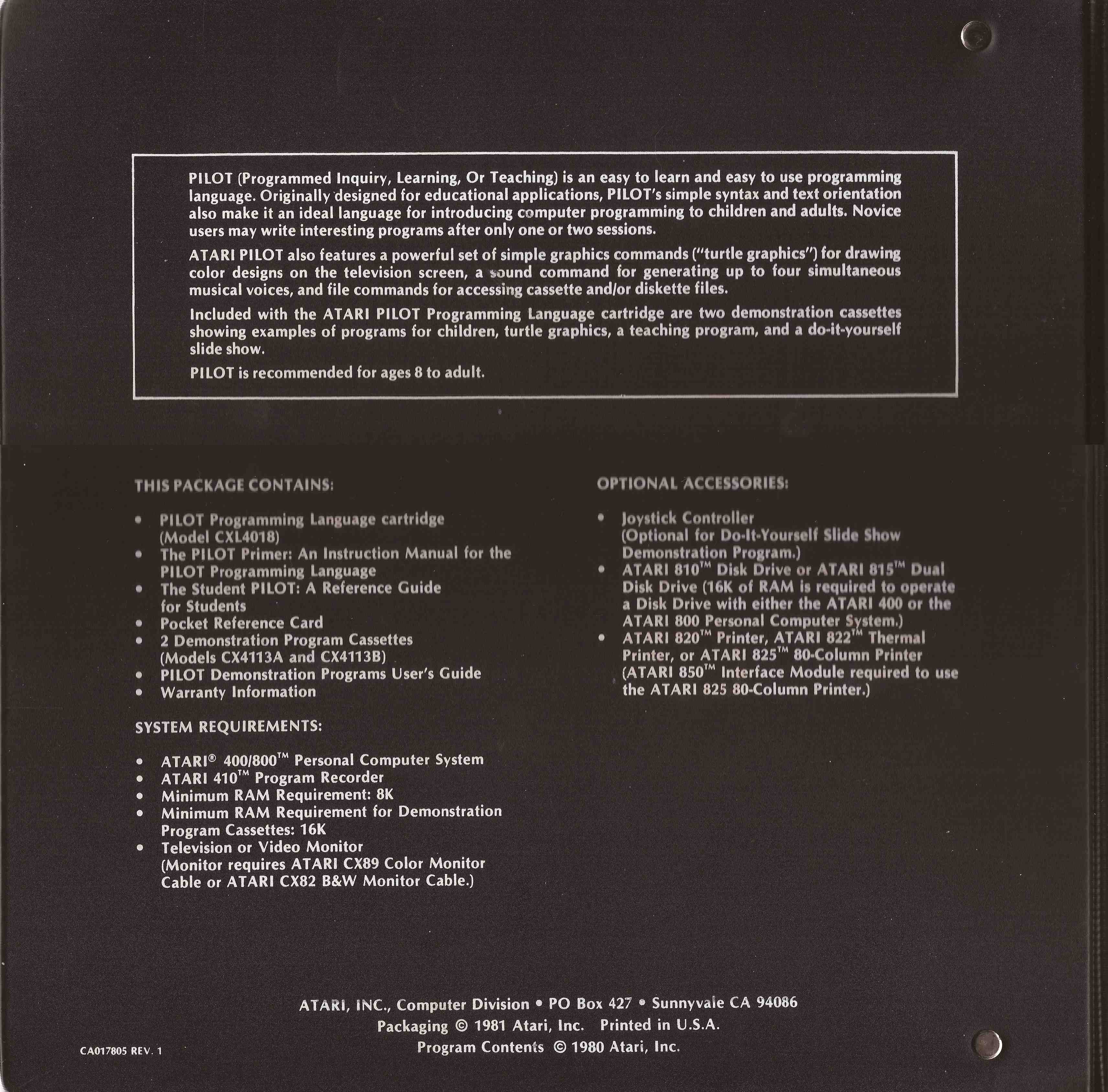
PILOT dates from 1972, when John Starkweather at the University of California, San Francisco designed it for writing tutorial programs. Atari's version was written by Harry B. Stewart, a consultant for Atari who also wrote the APX language Extended WSFN. Atari announced it at the Winter CES in January 1981 and shipped it in November–December 1981 in two forms. The Home Package had the cartridge and a user guide, for about $90. The Educators' Package (CX405), about $130, came in a large binder. It held the cartridge (CXL4018), the illustrated Student PILOT reference guide, the PILOT Primer for experienced programmers, a pocket reference card, a demonstration programs user's guide and two demonstration cassettes (CX4113A and CX4113B). The cassettes covered children's programs, turtle graphics, a teaching program and a do-it-yourself slide show. The binder states a minimum of 8K RAM, or 16K for the demonstration tapes, recommends PILOT for "ages 8 to adult", and dates the program contents to 1980.
Antic supported the language with a long-running "Pilot Your Atari" column, later "Logo/PILOT". Ken Harms wrote the early columns on colour, sound, string parsing and four-voice music. Kathy and Phil Bergh, authors of an APX PILOT program, added character redefinition and a math-drill program that merged files from disk while it ran. In his first column Harms recommended the Educators' Package. He also listed its rough edges: some syntax errors went uncaught, the manuals had no indexes and some commands were not documented at all. In 1983 Atari developed Super PILOT (also called PILOT II) for its computer camps, with four visible turtles and all graphics modes. It was announced for April 1984 but never shipped.
Using it today
Load the PILOT cartridge image in Altirra or another emulator on any 400/800 or XL/XE configuration. Disk and cassette images of the two Educators' Package demonstration tapes are preserved, and they are a good tour of what the language can do. PILOT is still a gentle first language for young children. Questions, answers and turtle drawings produce results in a few lines, and when a child is ready the C:@B command opens up the whole machine. If you are typing in Antic listings, note that PILOT's LOAD performs an automatic NEW when run from a program. The Berghs worked around this by writing the LOAD command to the screen and ending the program, so that the Atari's screen editor would execute it.
Credits
- Picture: The Atari PILOT Educators' Package binder. — Package front scan from AtariMania (Atari PILOT Educators' Package) (© Atari, Inc. — used for identification/commentary)
- Best of Antic Vol. 1 — Pilot Your Atari, Ken Harms — AtariMagazines.com (Kevin Savetz)
- Antic Vol. 1 No. 3 (August 1982) — Pilot Your Atari: Colors For Your Pilot, Ken Harms — AtariMagazines.com (Kevin Savetz), 1982
- Antic Vol. 1 No. 6 (February 1983) — Pilot Your Atari: Sounder, Ken Harms — AtariMagazines.com (Kevin Savetz), 1983
- Antic Vol. 2 No. 5 (August 1983) — Pilot Your Atari: Redefine Characters, Kathy and Phil Bergh — AtariMagazines.com (Kevin Savetz), 1983
- Antic Vol. 2 No. 12 (March 1984) — Merging Traffic, Phil and Kathy Bergh — AtariMagazines.com (Kevin Savetz), 1984
- Best of Antic Vol. 1 — The Musical Pilot, Ken Harms — AtariMagazines.com (Kevin Savetz)
- The Creative Atari (1983) — Atari Languages — AtariArchives.org, 1983
- AtariMania — PILOT (CX405) — Package front scan from AtariMania (Atari PILOT Educators' Package) (© Atari, Inc. — used for identification/commentary)
- comp.sys.atari.8bit FAQ (Michael Current) — timeline 1981 (CES announcement, Nov/Dec shipping), 1983–84 (Super PILOT), credits (Harry B. Stewart), .PLT extension — Michael Current (comp.sys.atari.8bit FAQ), 1981
- AtariMania — PILOT Educators' Package binder scans (front and back: contents, requirements, part numbers) — AtariMania